
Value anchoring: price of 2 vanilla lates
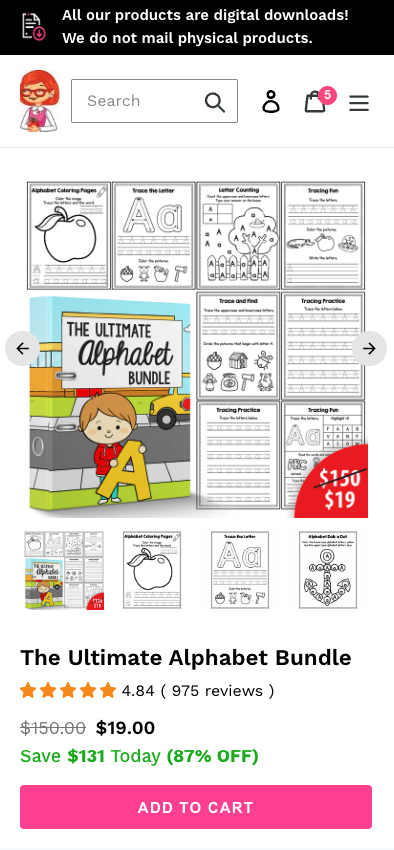
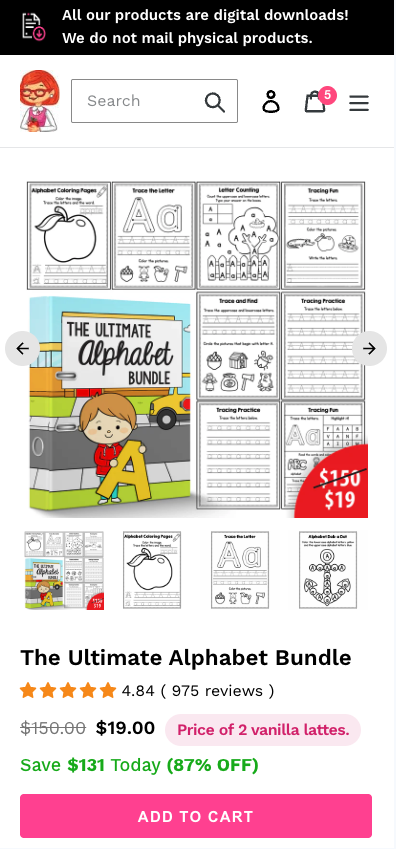
Hypothesis
If we add value reframing copy below the $19.00 price (either "Only $0.02 per sheet" or "Price of 2 vanilla lattes"), then conversion rate will increase, because presenting the price through a relatable micro-cost lens makes the extraordinary value immediately tangible and emotionally compelling, removing the mental friction teachers experience when trying to justify a $19 digital bundle purchase against familiar reference points like coffee or physical workbooks.
What we learned
What we tested: Added value anchoring copy below the $19.00 price on select product pages (bundles like the K-4th grade pack, Alphabet Bundle, Phonics & Spelling Rules, Math Mats, and Life Skills). The variation displayed a relatable micro-cost comparison ("Price of 2 vanilla lattes") to reframe the price and make the value feel more tangible. What happened: The original pricing display (Control) outperformed the value anchoring variation across all key metrics. - Conversion rate: Control 3.07% vs Variation 2.86% (7% drop for the variation) - Revenue per visitor: Control $0.87 vs Variation $0.78 (10% drop for the variation) - Average order value: Control $28.31 vs Variation $27.24 (4% drop for the variation) Statistical confidence: There is an 89% chance the Control is better for conversion rate and a 90% chance it is better for revenue per visitor. This is a strong level of confidence. Device breakdown: - Mobile (96% of traffic): Control won on both metrics. Conversion rate Control 2.79% vs Variation 2.64% (5% drop). Revenue per visitor Control $0.80 vs Variation $0.72 (10% drop). 81% chance Control is better on conversion rate, 89% on revenue per visitor. - Desktop (4% of traffic): Control won more strongly despite the small sample. Conversion rate Control 9.58% vs Variation 7.91% (17% drop). Revenue per visitor Control $2.55 vs Variation $2.21 (13% drop). 89% chance Control is better on desktop conversion rate. Note: small desktop sample (82 vs 69 orders) so interpret with caution. New vs returning visitors: - New visitors (78% of traffic): Control won clearly. Conversion rate Control 2.90% vs Variation 2.66% (8% drop). Revenue per visitor Control $0.81 vs Variation $0.72 (11% drop). 90% chance Control is better on conversion rate, 89% on revenue per visitor. This is statistically significant. - Returning visitors (22% of traffic): Results leaned toward Control but were not statistically significant. Conversion rate Control 3.66% vs Variation 3.59% (2% drop). Revenue per visitor Control $1.06 vs Variation $0.98 (7% drop). Only 57% chance Control is better on conversion rate, essentially a coin flip. Why it matters: The hypothesis was that reframing the $19 price as "the price of 2 vanilla lattes" would make the value more tangible and reduce purchase hesitation. The data shows the opposite, the anchoring copy actually hurt conversions, particularly among new visitors and on desktop. One possible explanation is that the latte comparison inadvertently drew attention to the price as a cost rather than reinforcing the discount already displayed (87% off). The existing pricing display ($150 strikethrough, $19 sale price, "Save $131 Today") already communicates strong value. Adding a coffee comparison may have introduced cognitive friction by making visitors pause and evaluate the price from a different angle, rather than simply accepting the dramatic discount. The effect was strongest among new visitors, who may be more price-sensitive and more susceptible to any element that slows down their purchase decision. Note: This test ran for approximately 7 days (March 13–20, 2026) with ~41,500 total visitors and ~1,230 orders, providing a solid sample size for reliable directional results.
Want an agency that shows you its losses?
Every agency has losing tests. We're the ones who publish them. Free teardown: we walk your store live and show you the three highest-impact tests we would run first.